 |
About UoN | Academic Affairs | Research | Resources and Services |  |
عربي |

|

|
About UoN | Academic Affairs | Research | Resources and Services | |
عربي |
|

The Value and Process of Institutional and Program Accreditation
A major focus of the DPQM activities is on facilitating the UoN OAAA Institutional and Program Accreditation. The UoN is committed to the goals of the Oman Ministry of Higher Education, and institutional standards of the Oman Academic Accreditation Authority [refer to the websites of Oman Ministry of Higher Education (MoHE) Oman Academic Accreditation Authority (OAAA)]. Accreditation is an important goal sought by higher education institutions throughout the globe. The OAAA Institutional Accreditation, among other goals, is about academic excellence and organizational effectiveness and efficiency. Accreditation, institutional and program, is about students and the enhancement of learning and professional development.
The OAAA Institutional Accreditation: The Design & Basic Requirements
There are 9 Standards. These are the “accreditation areas” the OAAA will use to review and make a professional assessment on whether a Higher Education Institution (HEI) is meeting its responsibilities in accordance with its charter, national laws and regulations, its strategic & operational plan, Stage 1 Quality Audit Portfolio, and the OAAA Report of an Audit, among other aspects of an institution as stated in the HEI obligations to its stakeholders. In order to meet the OAAA Institutional Accreditation Stage 2 Institutional Standards Assessment, a number of criteria are provided under each standard; the OAAA Criteria “specify the requirements” for meeting a standard.
The OAAA process follows a “systems approach: inputs, processes, outputs, and feedback.” ADRI is the approach the OAAA has suggested that HEIs follow in addressing the 9 Accreditation Standards. ADRI is a decision-making tool designed to “guarantee” that colleges/universities are doing what they have said (Stage 1 Quality Audit Portfolio) are doing. For every area of a HEI responsibility (for example academic), the HEI should have an Approach (A), should have Deployment ofits plan (D), should evaluate its plan on a periodic basis (Results (R)), and make necessary changes/modifications to enhance its plan (Improvement). These are the components of ADRI, it is a means to an end, a decision-making tool. The focus of accreditation is not on the tool. Rather, it is on the substance of the college/university information (about its practices) and how it is able to demonstrate that such practices are in conformance with the OAAA Institutional Standards.
Advancing Academic Excellence through National Recognition: The UoN Quality Management, System and Accreditation
The process used by the UoN to achieve institutional accreditation through the Oman Academic Accreditation Authority (OAAA) is pursued using a modified University Quality Management System. The OAAA has adopted a self-assessment model called ADRI (Approach, Deployment, Results, and Improvement) as a “tool” for higher education institutions’ internal and external quality assurance review. The UoN has adopted and implemented the OAAA approach to quality assurance using ADRI. The University has integrated ADRI into its Quality Management System as shown in the diagram below.
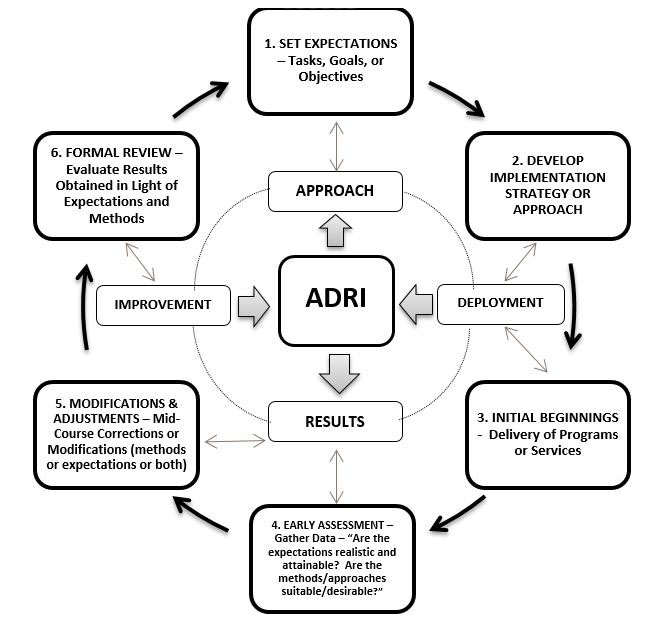
Aligning ADRI and the UoN Quality Management System has served to enhance the University culture of quality. Specifically, the UoN has utilized this integrated approach to address its operational planning expectations and the evaluation of their results to ascertain whether the institution is meeting its responsibilities not just for the sake of accreditation but to enhance academic excellence. The UoN firmly believes that institutional and program accreditation is a natural outcome of its focus on quality management. Integrating ADRI and the UoN Quality Management System has yielded a number of desired results.
The UoN Quality Management System and the ADRI self-assessment model have been utilized, in combination, to pursue institutional accreditation as a University of Nizwa strategic goal, a quality enhancement process to advance its focus on academic excellence. The combined approach to quality and its desired outcome of national accreditation consisted of a stakeholder-driven process that emphasized ownership and accountability in the development, implementation, maintenance and assessment of University plans and responsibilities, at all levels.
The outcomes of the implementation of the above-stated integrated system of quality and self-assessment has enhanced not only the culture of quality and its desired goal of achieving recognition through accreditation and rankings, but also it has created a mindset among stakeholders that the UoN emphasis on quality is essential to supporting the University Strategic Operational Plans.