 |
About UoN | Academic Affairs | Research | Resources and Services |  |
عربي |

|
|
About UoN | Academic Affairs | Research | Resources and Services | |
عربي |
|

| ◄ Previous | Next ► |
From Nizwa’s Legacy of Scholarship to Rome’s Intellectual Horizons: University of Nizwa Doctoral Researchers Strengthen Oman’sAcademic Presence at an International Scientific Conference The University of Nizwa demonstrates the strength of its doctoral research training and its commitment to advancing Arabic language scholarship through two distinguished research contributions that bridge the richness of the Arab intellectual heritage with contemporary linguistic methodologies. From the academic halls of the University of Nizwa, where a distinguished intellectual heritage meets an ever-expanding commitment to scholarly inquiry, Omani academic excellence reached the Italian capital, Rome, through the participation of two second-year doctoral researchers enrolled in the PhD program in Arabic Language and Literature at the College of Arts and Sciences, Department of Arabic Language. The researchers participated in the 18th International Scientific Conference of the European Center for Research and Consultancy in the Humanities and Social Sciences, held in Rome, Italy, on 3–4 November 2026, under the theme “Humanities and Social Sciences: Concepts and Applications.” Their participation reflects the University of Nizwa’s dynamic research environment and its sustained commitment to developing highly qualified scholars equipped with rigorous methodological expertise, advanced analytical skills, and the intellectual confidence to contribute meaningfully to international academic discourse.
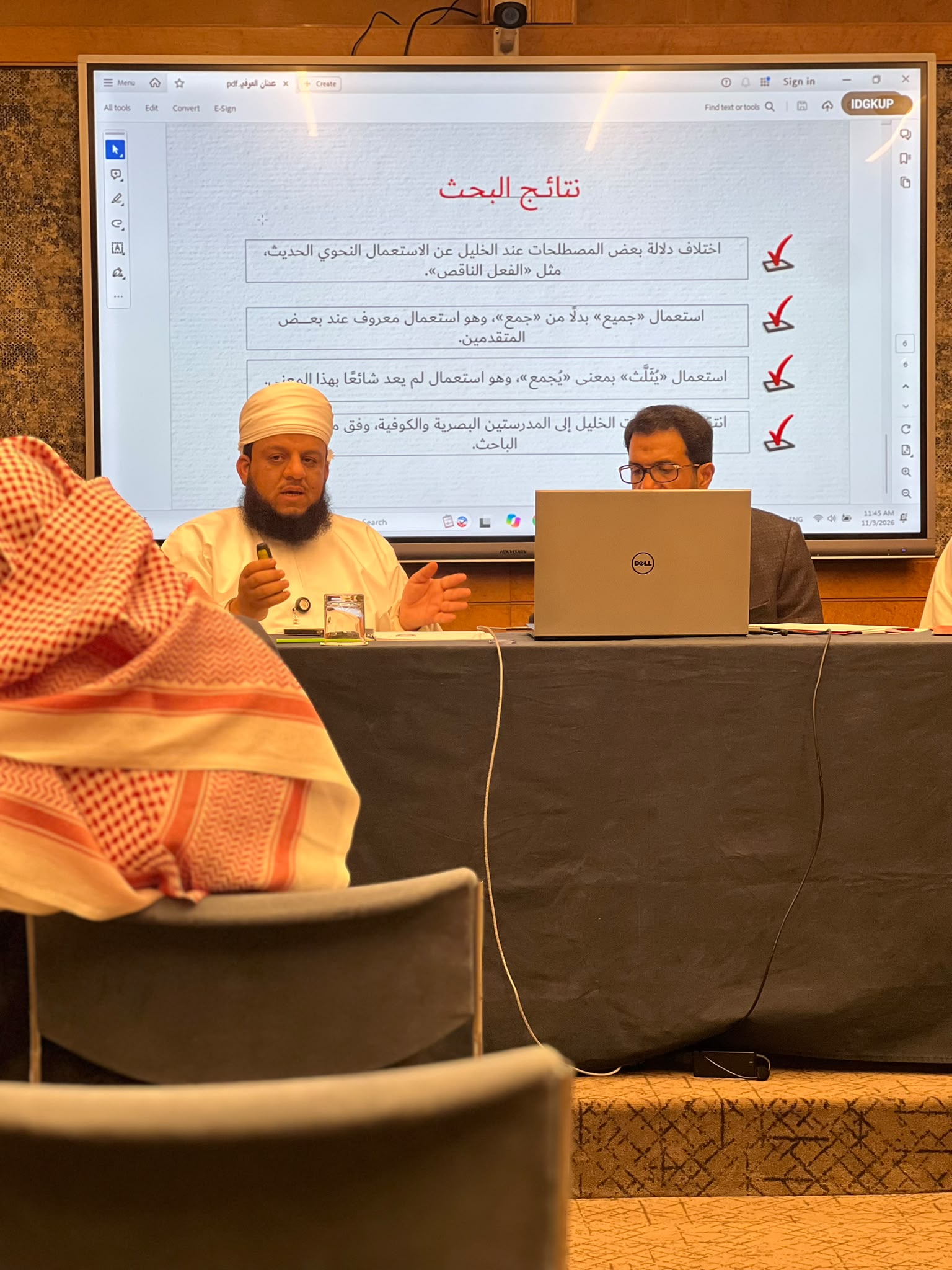
As part of the conference proceedings, Adnan bin Nasser bin Said Al-Awfi presented a research paper entitled “Grammatical Terminology in the Works of Al-Khalil ibn Ahmad Al-Farahidi: A Study Based on Kitab Al-Ayn.” His study explored the grammatical and terminological dimensions of Al-Khalil ibn Ahmad Al-Farahidi’s linguistic legacy, demonstrating that Kitab Al-Ayn extends far beyond its conventional classification as a lexicographical work. Through a systematic examination of selected grammatical terms, the research highlighted Al-Farahidi’s pioneering contributions to the foundations of Arabic linguistic thought, while reaffirming the profound historical significance of Oman’s intellectual and civilizational contributions to the development of Arabic scholarship.
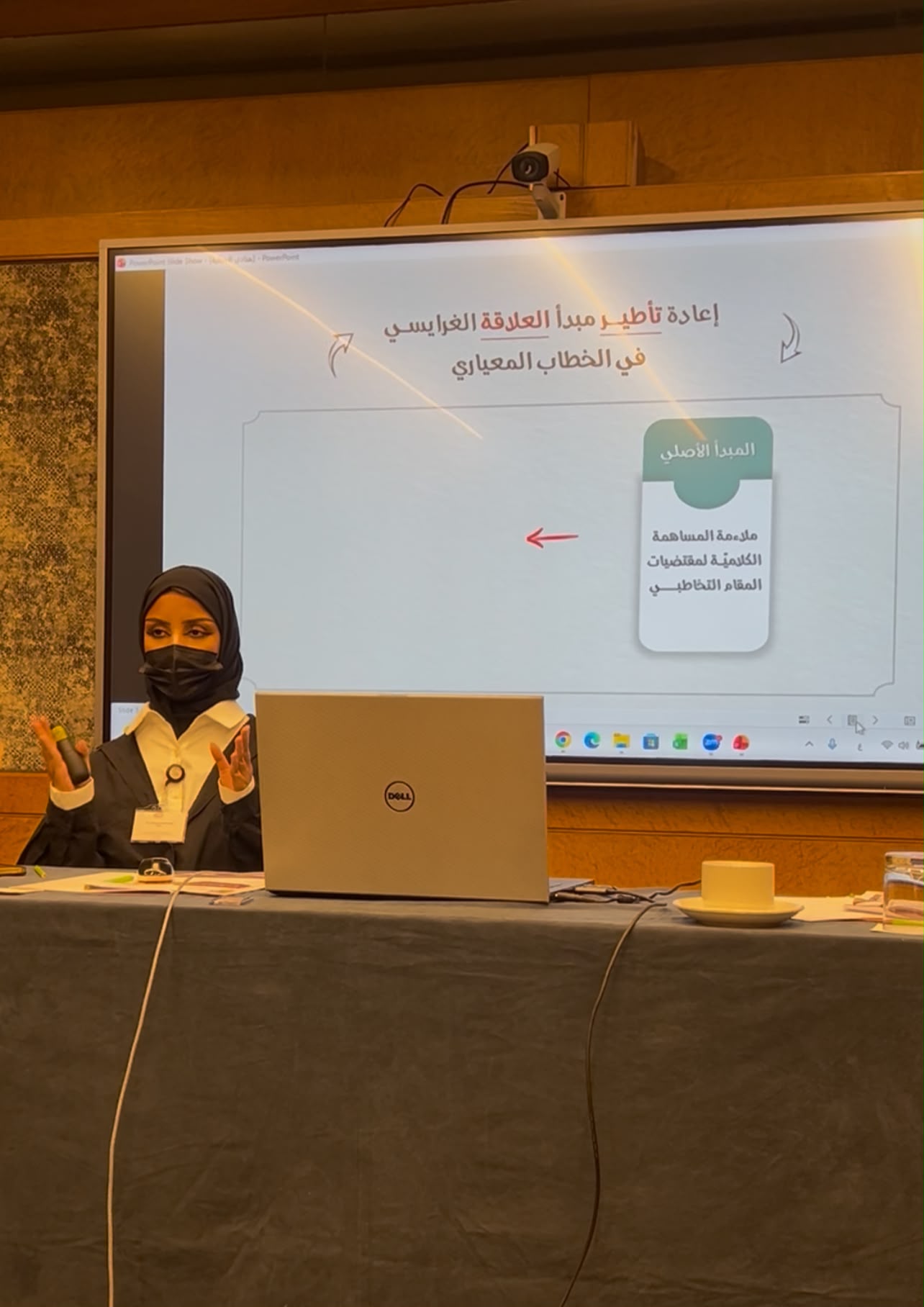
Hanadi Imad Al-Attiyah also contributed a research paper entitled “The Operation of Grice’s Maxim of Relation in Qatari Criminal Legal Texts: A Pragmatic Approach to the Relationship Between Criminalized Acts and Punishments.” Her research addressed a significant theoretical and methodological question concerning the application of pragmatic principles beyond their original conversational contexts, particularly within the normative and prescriptive framework of criminal legal discourse. Drawing upon Grice’s Maxim of Relation, the study investigated the relationship between criminalized conduct and corresponding legal penalties, integrating theoretical foundations with applied textual analysis. In doing so, it opened promising interdisciplinary perspectives at the intersection of linguistics, pragmatics, and legal studies. This participation further builds upon her previous academic engagement at a scientific conference hosted by Sultan Qaboos University, reflecting her continuing commitment to scholarly development and research excellence. The significance of these two contributions lies in their intellectual depth, methodological diversity, and complementary research perspectives. Together, they demonstrate the capacity of contemporary Arabic linguistic scholarship to engage critically with its classical intellectual foundations while embracing advanced theoretical approaches and interdisciplinary research. Such scholarly engagement reflects the academic training provided by the College of Arts and Sciences and the pivotal role of the Department of Arabic Language in preparing doctoral researchers capable of conducting sophisticated analyses, developing original research questions, and contributing to specialized international academic discussions. It also underscores the University of Nizwa’s broader institutional commitment to academic excellence. Throughout its development, the University has sought to foster a supportive environment for teaching, learning, and scientific inquiry by strengthening academic supervision, developing research competencies, and providing the intellectual, educational, technological, logistical, and material resources necessary to advance higher education and scholarly productivity. Through these sustained efforts, the University continues to pursue a prominent role in advancing higher education and research excellence at the national, regional, and international levels. This international participation affirms that the University of Nizwa is committed not merely to transmitting knowledge, but to cultivating scholars capable of generating new knowledge, refining research methodologies, and expanding the frontiers of academic inquiry. By investing in rigorous doctoral training, research mentorship, and international scholarly engagement, the University contributes to the development of a new generation of researchers equipped to participate confidently in global intellectual exchanges. Thus, from Nizwa, a historic center of learning and intellectual heritage, to Rome, a city renowned for its enduring civilizational legacy, the University of Nizwa continues to build bridges between tradition and innovation, between the Arab scholarly heritage and contemporary international research. These contributions reinforce the visibility of Omani scholarship within Arab and global academic communities, while affirming that investing in researchers, nurturing intellectual talent, and sustaining academic excellence are essential foundations for universities seeking to shape knowledge and contribute to human civilization. |